驱动适配层
相关文件
frameworks/base/include/utils/IPCThreadState.h
frameworks/base/libs/utils/IPCThreadState.cpp
frameworks/base/include/utils/ProcessState.h
frameworks/base/include/utils/ProcessState.cpp
frameworks/base/media/mediaserver/main_mediaserver.cpp
适配层模型
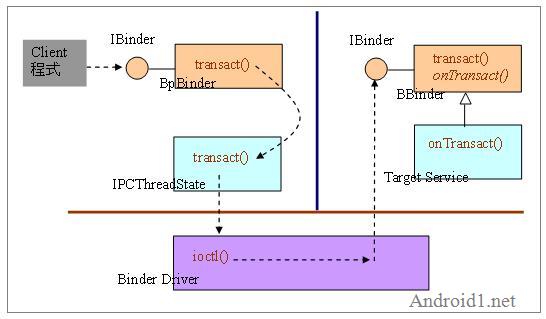
适配层本质上实现了如何与驱动通信的方法,ProcessState用来打开Binder,所有数据传递操作放在IPCThreadState处理。
mediaserver的范例
- 我们以mediaserver的源码作为例子,讲述适配层在Binder通信中的作用,首先从mediaserver.cpp的main方法开始。
Binder初始化阶段
-
ProcessState::self()用来初始化ProcessState的单例对象,其构造方法会调用
open_driver()方法负责打开Binder即/dev/binder设备,映射1M的内存,为进程间通信做准备。 -
接下来
defaultServiceManager()会获取ServiceManager的Binder引用,为以后在ServiceManager中注册服务做准备。(参见守护进程的驱动者)
向Binder驱动注册服务
-
为每个服务做初始化,分别是调用各自的
::instantiate(),可参考CameraService.cpp的实现。 -
在初始化过程中会向Binder服务注册各自服务的Binder对象,调用
addService()。使用IServiceManager来实现,参见守护进程的驱动者
Binder消息处理阶段
-
通过
ProcessState::startThreadPool()方法和ProcessState::spawnPooledThread(bool isMain)方法开启线程。 -
IPCThreadState.joinThreadPool()方法建立消息处理循环,它会调用PoolThread的threadLoop()方法为线程执行的入口方法。 -
当client呼叫
BpBinder的IBinder的transact()方法,该transact()则呼叫IPCThreadState的transact()方法。 -
transact()会调用
talkWithDriver(),该方法会用到ProcessState初始化时打开的文件描述符和Binder驱动交互,该方法有两个职责:-
接收来自驱动的请求(即代理端请求)。发送和接收的数据都被写入binder_write_read数据结构,最终通过
ioctl()方法调用与驱动交互。 - 必要时发送结果给驱动(回复代理端请求);
-
接收来自驱动的请求(即代理端请求)。发送和接收的数据都被写入binder_write_read数据结构,最终通过
-
处理请求的方法是
executeCommand(),BR_TRANSACTION响应会读取请求数据,将Binder地址换成BBinder,并调用它的transact()方法处理请求,同时BBinder的继承类会调用它的onTransact()方法。当处理请求后会将结果写入reply并返回。 -
回到executeCommand()方法,如果当前处于同步模式,则会调用
sendReply()方法,它先将结果打包进binder_transaction_data,再调用waitForResponse()提交给驱动。 - 线程不断循环重复以上数据交换的流程直到退出循环。
要点总结
- ProcessState是对进程的抽象类,该类保证了在一个进程中对于设备节点/dev/binder只会被打开一次,它使用单例模式,对象通过ProcessState::self()获取。
- IPCThreadState是对处理线程的抽象类,该类保证了与驱动交互的行为只会在一个线程中被执行,它使用单例模式,对象通过IPCThreadState::self()获取。该类会使用ProcessState对象来取得驱动设备描述符。
- IPCThreadState的实现遵循了Binder协议,它将传输数据封装成binder_transaction_data结构。请求和应答都使用Parcel作为传输介质。(参见Parcel传输介质)
mediaserver.cpp
main
int main(int argc, char** argv)
{
    sp<ProcessState> proc(ProcessState::self());
    sp<IServiceManager> sm = defaultServiceManager();
    AudioFlinger::instantiate();
    MediaPlayerService::instantiate();
    CameraService::instantiate();
    AudioPolicyService::instantiate();
    ProcessState::self()->startThreadPool();
    IPCThreadState::self()->joinThreadPool();
}
CameraService.cpp
CameraService::instantiate
void CameraService::instantiate() {
    defaultServiceManager()->addService(
            String16("media.camera"), new CameraService());
}
ProcessState.cpp
ProcessState::ProcessState
-
该构造方法做打开驱动的初始化,并映射内存,初始化时调用
open_driver方法。
ProcessState::ProcessState()
    : mDriverFD(open_driver())
    , mVMStart(MAP_FAILED)
    , mManagesContexts(false)
    , mBinderContextCheckFunc(NULL)
    , mBinderContextUserData(NULL)
    , mThreadPoolStarted(false)
    , mThreadPoolSeq(1)
{
    if (mDriverFD >= 0) {
        // XXX Ideally, there should be a specific define for whether we
        // have mmap (or whether we could possibly have the kernel module
        // availabla).
#if !defined(HAVE_WIN32_IPC)
        // mmap the binder, providing a chunk of virtual address space to receive transactions.
        mVMStart = mmap(0, BINDER_VM_SIZE, PROT_READ, MAP_PRIVATE | MAP_NORESERVE, mDriverFD, 0);
        if (mVMStart == MAP_FAILED) {
            // *sigh*
            close(mDriverFD);
            mDriverFD = -1;
        }
#else
        mDriverFD = -1;
#endif
    }
    if (mDriverFD < 0) {
        // Need to run without the driver, starting our own thread pool.
    }
}
ProcessState::self
- 单例模式的类,用来构造ProcessState对象。
sp<ProcessState> ProcessState::self()
{
    if (gProcess != NULL) return gProcess;

    AutoMutex _l(gProcessMutex);
    if (gProcess == NULL) gProcess = new ProcessState;
    return gProcess;
}
open_driver
- 打开驱动设备,返回描述符。
// 全局变量gSingleProcess初始为false
static int open_driver()
{
    if (gSingleProcess) {
        return -1;
    }

    int fd = open("/dev/binder", O_RDWR);
    if (fd >= 0) {
        ......
    } else {
    }
    return fd;
}
startThreadPool
void ProcessState::startThreadPool()
{
    AutoMutex _l(mLock);
    if (!mThreadPoolStarted) {
        mThreadPoolStarted = true;
        spawnPooledThread(true);
    }
}
spawnPooledThread
void ProcessState::spawnPooledThread(bool isMain)
{
    if (mThreadPoolStarted) {
        int32_t s = android_atomic_add(1, &mThreadPoolSeq);
        char buf[32];
        sprintf(buf, "Binder Thread #%d", s);
        sp<Thread> t = new PoolThread(isMain);
        t->run(buf);
    }
}
getContextObject 方法1
sp<IBinder> ProcessState::getContextObject(const sp<IBinder>& caller)
{
    if (supportsProcesses()) {
        // 根据0句柄查找ServiceManager
        return getStrongProxyForHandle(0);
    } else {
        return getContextObject(String16("default"), caller);
    }
}
getContextObject 方法2
sp<IBinder> ProcessState::getContextObject(const String16& name, const sp<IBinder>& caller)
{
    mLock.lock();
    sp<IBinder> object(
        mContexts.indexOfKey(name) >= 0 ? mContexts.valueFor(name) : NULL);
    mLock.unlock();

    if (object != NULL) return object;

    // Don't attempt to retrieve contexts if we manage them
    if (mManagesContexts) {
        return NULL;
    }

    // 取得IPC通信渠道
    IPCThreadState* ipc = IPCThreadState::self();
    {
        // 封装Binder的请求数据
        Parcel data, reply;
        data.writeString16(name);
        data.writeStrongBinder(caller);
        // 向0号引用的ServiceManager发送请求
        status_t result = ipc->transact(0 /*magic*/, 0, data, &reply, 0);
        if (result == NO_ERROR) {
            object = reply.readStrongBinder();
        }
    }

    ipc->flushCommands();

    if (object != NULL) setContextObject(object, name);
    return object;
}
getStrongProxyForHandle
sp<IBinder> ProcessState::getStrongProxyForHandle(int32_t handle)
{
    sp<IBinder> result;

    AutoMutex _l(mLock);

    handle_entry* e = lookupHandleLocked(handle);

    if (e != NULL) {
        // We need to create a new BpBinder if there isn't currently one, OR we
        // are unable to acquire a weak reference on this current one.  See comment
        // in getWeakProxyForHandle() for more info about this.
        IBinder* b = e->binder;
        if (b == NULL || !e->refs->attemptIncWeak(this)) {
            b = new BpBinder(handle);
            e->binder = b;
            if (b) e->refs = b->getWeakRefs();
            result = b;
        } else {
            // This little bit of nastyness is to allow us to add a primary
            // reference to the remote proxy when this team doesn't have one
            // but another team is sending the handle to us.
            result.force_set(b);
            e->refs->decWeak(this);
        }
    }

    return result;
}
ProcessState::getWeakProxyForHandle
wp<IBinder> ProcessState::getWeakProxyForHandle(int32_t handle)
{
    wp<IBinder> result;

    AutoMutex _l(mLock);

    handle_entry* e = lookupHandleLocked(handle);

    if (e != NULL) {
        // We need to create a new BpBinder if there isn't currently one, OR we
        // are unable to acquire a weak reference on this current one.  The
        // attemptIncWeak() is safe because we know the BpBinder destructor will always
        // call expungeHandle(), which acquires the same lock we are holding now.
        // We need to do this because there is a race condition between someone
        // releasing a reference on this BpBinder, and a new reference on its handle
        // arriving from the driver.
        IBinder* b = e->binder;
        if (b == NULL || !e->refs->attemptIncWeak(this)) {
            b = new BpBinder(handle);
            result = b;
            e->binder = b;
            if (b) e->refs = b->getWeakRefs();
        } else {
            result = b;
            e->refs->decWeak(this);
        }
    }

    return result;
}
PoolThread类
class PoolThread : public Thread
{
public:
    PoolThread(bool isMain)
        : mIsMain(isMain)
    {
    }

protected:
    virtual bool threadLoop()
    {
        // 通知驱动进入Loop模式,线程的入口函数
        IPCThreadState::self()->joinThreadPool(mIsMain);
        return false;
    }

    const bool mIsMain;
};
IServiceManager.cpp
defaultServiceManager
- 该方法返回ServiceManager的Binder引用。
if (gDefaultServiceManager != NULL) return gDefaultServiceManager;

    {
        AutoMutex _l(gDefaultServiceManagerLock);
        if (gDefaultServiceManager == NULL) {
            gDefaultServiceManager = interface_cast<IServiceManager>(
                ProcessState::self()->getContextObject(NULL));
        }
    }

    return gDefaultServiceManager;
IPCThreadState.cpp
IPCThreadState::IPCThreadState
IPCThreadState::IPCThreadState()
    : mProcess(ProcessState::self())
{
    pthread_setspecific(gTLS, this);
        clearCaller();
    // 初始化接收和返回数据的Parcel对象
    mIn.setDataCapacity(256);
    mOut.setDataCapacity(256);
}
IPCThreadState::self
IPCThreadState* IPCThreadState::self()
{
    if (gHaveTLS) {
restart:
        const pthread_key_t k = gTLS;
        IPCThreadState* st = (IPCThreadState*)pthread_getspecific(k);
        if (st) return st;
        // 创建IPCThreadState对象
        return new IPCThreadState;
    }

    if (gShutdown) return NULL;

    pthread_mutex_lock(&gTLSMutex);
    if (!gHaveTLS) {
        if (pthread_key_create(&gTLS, threadDestructor) != 0) {
            pthread_mutex_unlock(&gTLSMutex);
            return NULL;
        }
        gHaveTLS = true;
    }
    pthread_mutex_unlock(&gTLSMutex);
    goto restart;
}
joinThreadPool
void IPCThreadState::joinThreadPool(bool isMain)
{
    // 通知驱动进入BC_ENTER_LOOPER模式
    mOut.writeInt32(isMain ? BC_ENTER_LOOPER : BC_REGISTER_LOOPER);

    // 进入消息接收循环
    status_t result;
    do {
        int32_t cmd;

        // When we've cleared the incoming command queue, process any pending derefs
        if (mIn.dataPosition() >= mIn.dataSize()) {
            size_t numPending = mPendingWeakDerefs.size();
            if (numPending > 0) {
                for (size_t i = 0; i < numPending; i++) {
                    RefBase::weakref_type* refs = mPendingWeakDerefs[i];
                    refs->decWeak(mProcess.get());
                }
                mPendingWeakDerefs.clear();
            }

            numPending = mPendingStrongDerefs.size();
            if (numPending > 0) {
                for (size_t i = 0; i < numPending; i++) {
                    BBinder* obj = mPendingStrongDerefs[i];
                    obj->decStrong(mProcess.get());
                }
                mPendingStrongDerefs.clear();
            }
        }

        // 与Binder驱动进行交互
        result = talkWithDriver();
        if (result >= NO_ERROR) {
            size_t IN = mIn.dataAvail();
            if (IN < sizeof(int32_t)) continue;
            cmd = mIn.readInt32();

            // 根据驱动的返回结果做出相应的动作
            result = executeCommand(cmd);
        }

        // After executing the command, ensure that the thread is returned to the
        // default cgroup and priority before rejoining the pool.  This is a failsafe
        // in case the command implementation failed to properly restore the thread's
        // scheduling parameters upon completion.
        int my_id;
#ifdef HAVE_GETTID
        my_id = gettid();
#else
        my_id = getpid();
#endif
        if (!set_sched_policy(my_id, SP_FOREGROUND)) {
            // success; reset the priority as well
            setpriority(PRIO_PROCESS, my_id, ANDROID_PRIORITY_NORMAL);
        }

        // Let this thread exit the thread pool if it is no longer
        // needed and it is not the main process thread.
        if(result == TIMED_OUT && !isMain) {
            break;
        }
    } while (result != -ECONNREFUSED && result != -EBADF);


    mOut.writeInt32(BC_EXIT_LOOPER);
    talkWithDriver(false);
}
talkWithDriver
- 该方法将mIn、mOut数据写入binder_write_read结构,并通过ioctl与驱动交互。参见Binder通信协议。
status_t IPCThreadState::talkWithDriver(bool doReceive)
{
    // Binder驱动ioctl需要binder_write_read结构作为参数
    binder_write_read bwr;

    // 从mIn.dataSize判断是否需要读驱动的数据
    const bool needRead = mIn.dataPosition() >= mIn.dataSize();

    // We don't want to write anything if we are still reading
    // from data left in the input buffer and the caller
    // has requested to read the next data.
    const size_t outAvail = (!doReceive || needRead) ? mOut.dataSize() : 0;

    bwr.write_size = outAvail;
    bwr.write_buffer = (long unsigned int)mOut.data();

    // This is what we'll read.
    if (doReceive && needRead) {
        bwr.read_size = mIn.dataCapacity();
        bwr.read_buffer = (long unsigned int)mIn.data();
    } else {
        bwr.read_size = 0;
    }

    // Return immediately if there is nothing to do.
    if ((bwr.write_size == 0) && (bwr.read_size == 0)) return NO_ERROR;

    bwr.write_consumed = 0;
    bwr.read_consumed = 0;
    status_t err;
    do {
#if defined(HAVE_ANDROID_OS)
        // 将BINDER_WRITE_READ结构数据写入驱动
        if (ioctl(mProcess->mDriverFD, BINDER_WRITE_READ, &bwr) >= 0)
            err = NO_ERROR;
        else
            err = -errno;
#else
        err = INVALID_OPERATION;
#endif
    } while (err == -EINTR);

    if (err >= NO_ERROR) {
        if (bwr.write_consumed > 0) {
            if (bwr.write_consumed < (ssize_t)mOut.dataSize())
                mOut.remove(0, bwr.write_consumed);
            else
                mOut.setDataSize(0);
        }
        if (bwr.read_consumed > 0) {
            mIn.setDataSize(bwr.read_consumed);
            mIn.setDataPosition(0);
        }

        return NO_ERROR;
    }

    return err;
}
transact
- 该方法首先将数据封装成binder_transaction_data结构,再判断异步或同步数据处理。
status_t IPCThreadState::transact(int32_t handle,
                                  uint32_t code, const Parcel& data,
                                  Parcel* reply, uint32_t flags)
{
    status_t err = data.errorCheck();

    flags |= TF_ACCEPT_FDS;

    if (err == NO_ERROR) {
        // 将数据封装成binder_transaction_data数据包结构
        err = writeTransactionData(BC_TRANSACTION, flags, handle, code, data, NULL);
    }

    if (err != NO_ERROR) {
        if (reply) reply->setError(err);
        return (mLastError = err);
    }

    // TF_ONE_WAY表示异步处理
    if ((flags & TF_ONE_WAY) == 0) {
        // 同步模式,则等待驱动应答
        if (reply) {
            err = waitForResponse(reply);
        } else {
            Parcel fakeReply;
            err = waitForResponse(&fakeReply);
        }
    } else {
        // 异步模式,则传递NULL作为参数
        err = waitForResponse(NULL, NULL);
    }

    return err;
}
writeTransactionData
- 首先将数据封装进binder_transaction_data结构中,再将该结构的数据写入mOut,下次与驱动交互时再将该数据写入驱动。
status_t IPCThreadState::writeTransactionData(int32_t cmd, uint32_t binderFlags,
    int32_t handle, uint32_t code, const Parcel& data, status_t* statusBuffer)
{
    binder_transaction_data tr;

    tr.target.handle = handle;
    tr.code = code;
    tr.flags = binderFlags;

    const status_t err = data.errorCheck();
    if (err == NO_ERROR) {
        tr.data_size = data.ipcDataSize();
        tr.data.ptr.buffer = data.ipcData();
        tr.offsets_size = data.ipcObjectsCount()*sizeof(size_t);
        tr.data.ptr.offsets = data.ipcObjects();
    } else if (statusBuffer) {
        tr.flags |= TF_STATUS_CODE;
        *statusBuffer = err;
        tr.data_size = sizeof(status_t);
        tr.data.ptr.buffer = statusBuffer;
        tr.offsets_size = 0;
        tr.data.ptr.offsets = NULL;
    } else {
        return (mLastError = err);
    }

    mOut.writeInt32(cmd);
    mOut.write(&tr, sizeof(tr));

    return NO_ERROR;
}
waitForResponse
status_t IPCThreadState::waitForResponse(Parcel *reply, status_t *acquireResult)
{
    int32_t cmd;
    int32_t err;

    while (1) {
        // 调用了talkWithDriver()与驱动交互
        if ((err=talkWithDriver()) < NO_ERROR) break;
        err = mIn.errorCheck();
        if (err < NO_ERROR) break;
        if (mIn.dataAvail() == 0) continue;

        cmd = mIn.readInt32();

        switch (cmd) {
        case BR_TRANSACTION_COMPLETE:
            if (!reply && !acquireResult) goto finish;
            break;

        case BR_DEAD_REPLY:
            err = DEAD_OBJECT;
            goto finish;

        case BR_FAILED_REPLY:
            err = FAILED_TRANSACTION;
            goto finish;

        case BR_ACQUIRE_RESULT:
            {
                const int32_t result = mIn.readInt32();
                if (!acquireResult) continue;
                *acquireResult = result ? NO_ERROR : INVALID_OPERATION;
            }
            goto finish;

        case BR_REPLY:
            {
                binder_transaction_data tr;
                err = mIn.read(&tr, sizeof(tr));
                if (err != NO_ERROR) goto finish;

                if (reply) {
                    if ((tr.flags & TF_STATUS_CODE) == 0) {
                        reply->ipcSetDataReference(
                            reinterpret_cast<const uint8_t*>(tr.data.ptr.buffer),
                            tr.data_size,
                            reinterpret_cast<const size_t*>(tr.data.ptr.offsets),
                            tr.offsets_size/sizeof(size_t),
                            freeBuffer, this);
                    } else {
                        err = *static_cast<const status_t*>(tr.data.ptr.buffer);
                        freeBuffer(NULL,
                            reinterpret_cast<const uint8_t*>(tr.data.ptr.buffer),
                            tr.data_size,
                            reinterpret_cast<const size_t*>(tr.data.ptr.offsets),
                            tr.offsets_size/sizeof(size_t), this);
                    }
                } else {
                    freeBuffer(NULL,
                        reinterpret_cast<const uint8_t*>(tr.data.ptr.buffer),
                        tr.data_size,
                        reinterpret_cast<const size_t*>(tr.data.ptr.offsets),
                        tr.offsets_size/sizeof(size_t), this);
                    continue;
                }
            }
            goto finish;

        default:
            err = executeCommand(cmd);
            if (err != NO_ERROR) goto finish;
            break;
        }
    }

finish:
    if (err != NO_ERROR) {
        if (acquireResult) *acquireResult = err;
        if (reply) reply->setError(err);
        mLastError = err;
    }

    return err;
}
executeCommand
- 该方法执行具体的Binder相关命令操作。
-
重点看BR_TRANSACTION部分,该类将读出的Binder数据转换成
BBinder,并调用它的transact()方法。最终将调用BBinder的继承类Bn*Service的onTransact()方法。
status_t IPCThreadState::executeCommand(int32_t cmd)
{
    BBinder* obj;
    RefBase::weakref_type* refs;
    status_t result = NO_ERROR;

    switch (cmd) {
    case BR_ERROR:
        result = mIn.readInt32();
        break;

    case BR_OK:
        break;

    case BR_ACQUIRE:
        refs = (RefBase::weakref_type*)mIn.readInt32();
        obj = (BBinder*)mIn.readInt32();
        obj->incStrong(mProcess.get());

        mOut.writeInt32(BC_ACQUIRE_DONE);
        mOut.writeInt32((int32_t)refs);
        mOut.writeInt32((int32_t)obj);
        break;

    case BR_RELEASE:
        refs = (RefBase::weakref_type*)mIn.readInt32();
        obj = (BBinder*)mIn.readInt32();

        mPendingStrongDerefs.push(obj);
        break;

    case BR_INCREFS:
        refs = (RefBase::weakref_type*)mIn.readInt32();
        obj = (BBinder*)mIn.readInt32();
        refs->incWeak(mProcess.get());
        mOut.writeInt32(BC_INCREFS_DONE);
        mOut.writeInt32((int32_t)refs);
        mOut.writeInt32((int32_t)obj);
        break;

    case BR_DECREFS:
        refs = (RefBase::weakref_type*)mIn.readInt32();
        obj = (BBinder*)mIn.readInt32();
        mPendingWeakDerefs.push(refs);
        break;

    case BR_ATTEMPT_ACQUIRE:
        refs = (RefBase::weakref_type*)mIn.readInt32();
        obj = (BBinder*)mIn.readInt32();

        {
            const bool success = refs->attemptIncStrong(mProcess.get());

            mOut.writeInt32(BC_ACQUIRE_RESULT);
            mOut.writeInt32((int32_t)success);
        }
        break;

    case BR_TRANSACTION:
        {
            binder_transaction_data tr;
            result = mIn.read(&tr, sizeof(tr));
            if (result != NO_ERROR) break;

            Parcel buffer;
            buffer.ipcSetDataReference(
                reinterpret_cast<const uint8_t*>(tr.data.ptr.buffer),
                tr.data_size,
                reinterpret_cast<const size_t*>(tr.data.ptr.offsets),
                tr.offsets_size/sizeof(size_t), freeBuffer, this);

            const pid_t origPid = mCallingPid;
            const uid_t origUid = mCallingUid;

            mCallingPid = tr.sender_pid;
            mCallingUid = tr.sender_euid;

            Parcel reply;
            if (tr.target.ptr) {
                // 将Binder的数据转换成BBinder,并调用它的transact方法,Bn*类即是继承于BBinder
                sp<BBinder> b((BBinder*)tr.cookie);
                const status_t error = b->transact(tr.code, buffer, &reply, 0);
                if (error < NO_ERROR) reply.setError(error);

            } else {
                const status_t error = the_context_object->transact(tr.code, buffer, &reply, 0);
                if (error < NO_ERROR) reply.setError(error);
            }

            // 如果是同步模式,则返回结果
            if ((tr.flags & TF_ONE_WAY) == 0) {
                sendReply(reply, 0);
            } else {
            }

            mCallingPid = origPid;
            mCallingUid = origUid;
        }
        break;

    case BR_DEAD_BINDER:
        {
            BpBinder *proxy = (BpBinder*)mIn.readInt32();
            proxy->sendObituary();
            mOut.writeInt32(BC_DEAD_BINDER_DONE);
            mOut.writeInt32((int32_t)proxy);
        } break;

    case BR_CLEAR_DEATH_NOTIFICATION_DONE:
        {
            BpBinder *proxy = (BpBinder*)mIn.readInt32();
            proxy->getWeakRefs()->decWeak(proxy);
        } break;

    case BR_FINISHED:
        result = TIMED_OUT;
        break;

    case BR_NOOP:
        break;

    case BR_SPAWN_LOOPER:
        mProcess->spawnPooledThread(false);
        break;

    default:
        printf("*** BAD COMMAND %d received from Binder driver\n", cmd);
        result = UNKNOWN_ERROR;
        break;
    }

    if (result != NO_ERROR) {
        mLastError = result;
    }

    return result;
}
incStrongHandle
void IPCThreadState::incStrongHandle(int32_t handle)
{
    mOut.writeInt32(BC_ACQUIRE);
    mOut.writeInt32(handle);
}
decStrongHandle
void IPCThreadState::decStrongHandle(int32_t handle)
{
    mOut.writeInt32(BC_RELEASE);
    mOut.writeInt32(handle);
}
incWeakHandle
void IPCThreadState::incWeakHandle(int32_t handle)
{
    mOut.writeInt32(BC_INCREFS);
    mOut.writeInt32(handle);
}
decWeakHandle
void IPCThreadState::decWeakHandle(int32_t handle)
{
    mOut.writeInt32(BC_DECREFS);
    mOut.writeInt32(handle);
}