HAL的C实现
标准模块定义(hardware.h)
-
该头文件定义了实现
HAL所需要的头文件,规范的实现方法需要继承以下定义这些结构-
struct hw_module_t; -
struct hw_module_methods_t; -
struct hw_device_t;
-
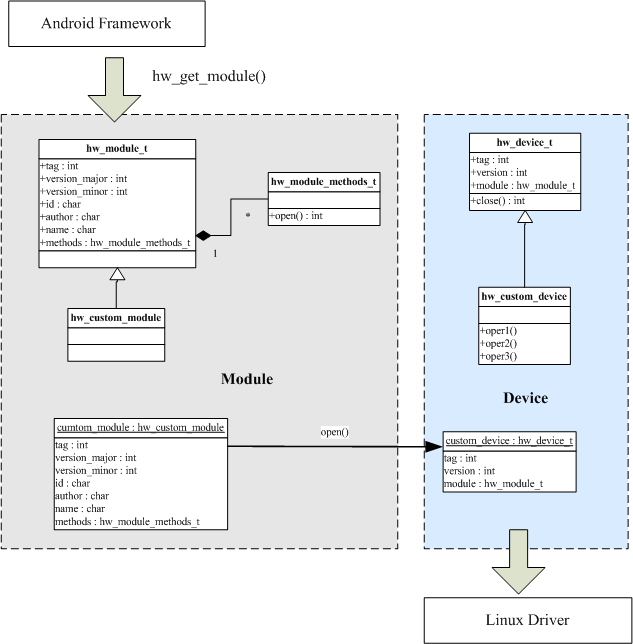
-
概括的说,就是定义一个hw_module_t模块对象,用该
模块对象的open方法初始化hw_device_t对象,最终的调用device设备对象的自定义方法对模块进行操作。
struct hw_module_t
/**
 * hw_module_t需要在实现代码中实例化,并且命名为HAL_MODULE_INFO_SYM,
 * 调用者通过通过hw_get_module方法获取该实例
 */
typedef struct hw_module_t {
    /** tag must be initialized to HARDWARE_MODULE_TAG */
    uint32_t tag;

    /** major version number for the module */
    uint16_t version_major;

    /** minor version number of the module */
    uint16_t version_minor;

    /** Identifier of module */
    const char *id;

    /** Name of this module */
    const char *name;

    /** Author/owner/implementor of the module */
    const char *author;

    /** Modules methods */
    struct hw_module_methods_t* methods;

    /** module's dso */
    void* dso;

    /** padding to 128 bytes, reserved for future use */
    uint32_t reserved[32-7];

} hw_module_t;
struct hw_module_methods_t
/*
 * hw_module_t包含的打开方法,通过该方法打开devices,并获取devices对象
 */
typedef struct hw_module_methods_t {
    /** Open a specific device */
    int (*open)(const struct hw_module_t* module, const char* id,
            struct hw_device_t** device);

} hw_module_methods_t;
struct hw_device_t
/**
 * device结构封装了设备的操作方法,子类继承该结构并包含模块对象
 */
typedef struct hw_device_t {
    /** tag must be initialized to HARDWARE_DEVICE_TAG */
    uint32_t tag;

    /** version number for hw_device_t */
    uint32_t version;

    /** reference to the module this device belongs to */
    struct hw_module_t* module;

    /** padding reserved for future use */
    uint32_t reserved[12];

    /** Close this device */
    int (*close)(struct hw_device_t* device);

} hw_device_t;
定义自定义HAL模块
led_module_t
// c语法继承自hw_module_t结构,定义LED stub模块
struct led_module_t {
    struct hw_module_t common;

    // 自定义的API
    int (*init_led)(struct led_control_device_t *dev);
};
led_control_device_t
// c语法继承自hw_device_t结构,定义LED device模块
struct led_control_device_t {
    struct hw_device_t common;

    int fd;

    // 设备的API
    int (*set_on)(struct led_control_device_t *dev, int32_t led);
    int (*set_off)(struct led_control_device_t *dev, int32_t led);
};
led_control_open
// 内嵌的初始化方法,用来获取device对象
static inline int led_control_open(const struct hw_module_t* module,
                                struct led_control_device_t** device) {
    return module->methods->open(module,
                    LED_HARDWARE_MODULE_ID, (struct hw_device_t**)device);
}
LED_HARDWARE_MODULE_ID
#define LED_HARDWARE_MODULE_ID "led"
实现自定义HAL模块
led_device_open
// 打开设备的方法,通过传入hw_device_t**,返回初始化的led_control_device_t对象
// 这里会将module传入led_control_device_t对象从而方便使用
// 另外还注册了led_device_close的方法用来关闭device
int led_device_open(const struct hw_module_t* module, const char* name,
        struct hw_device_t** device)
{
	struct led_control_device_t *dev;

    if (!strcmp(name, "led_control_open")) {
        dev = (struct led_control_device_t *)malloc(sizeof(*dev));
        memset(dev, 0, sizeof(*dev));

        dev->common.tag =  HARDWARE_DEVICE_TAG;
        dev->common.version = 0;
        dev->common.module = module;
        dev->common.close = led_device_close;

        dev->set_on = led_on;
        dev->set_off = led_off;

        *device = &dev->common;

        dev->fd = open("/dev/cdata-test", O_RDWR);
    }

success:
	return 0;
}
led_module_methods
// 初始化open方法
struct hw_module_methods_t led_module_methods = {
    open: led_device_open
};
struct led_module_t HAL_MODULE_INFO_SYM
// 初始化led_module_t实例,使用HAL_MODULE_INFO_SYM作为变量名,以供HAL层进行查找
// 这里会设置led_module_methods方法,以便初始化led_device_t
const struct led_module_t HAL_MODULE_INFO_SYM = {
    common: {
        tag: HARDWARE_MODULE_TAG,
        version_major: 1,
        version_minor: 0,
        id: LED_HARDWARE_MODULE_ID,
        name: "Sample LED Stub",
        author: "The Mokoid Open Source Project",
        methods: &led_module_methods,
    }

    // 可以实现其他API
};
LED示例
get_device_and_on
led_device* get_device_and_on() {
    int err;
    hw_module_t* module;
    led_device_t *led_device = NULL;

    // 初始化模块
    err = hw_get_module(LED_HARDWARE_MODULE_ID, (hw_module_t const**)&module);
    if (err == 0) {
        hw_device_t* dev;
        // 通过模块的open方法初始化device
        err = module->methods->open(module, "led_control_open", &dev);
        if (err == 0) {
            led_device = (led_device_t*)dev;
        }
    }

    return led_device;
}
GPS示例
- 参考GPS的HAL实现,可以给device添加一个描述操作接口的struct结构GpsInterface,和一个获取该接口的方法get_gps_interface,所有的操作可以封装在这个接口中,并在这个获取方法中初始化,最终用户可以通过一个方法获取到相关操作的接口。
GpsInterface
// 封装了方法的接口
typedef struct {
    size_t          size;

    int   (*init)( GpsCallbacks* callbacks );
    int   (*start)( void );
    int   (*stop)( void );

    void  (*cleanup)( void );
    int   (*inject_time)(GpsUtcTime time, int64_t timeReference,
                         int uncertainty);
    int  (*inject_location)(double latitude, double longitude, float accuracy);
    void  (*delete_aiding_data)(GpsAidingData flags);
    int   (*set_position_mode)(GpsPositionMode mode, GpsPositionRecurrence recurrence,
            uint32_t min_interval, uint32_t preferred_accuracy, uint32_t preferred_time);
    const void* (*get_extension)(const char* name);
} GpsInterface;
get_gps_interface
// 通过模块初始化接口
static const GpsInterface* get_gps_interface() {
    int err;
    hw_module_t* module;
    const GpsInterface* interface = NULL;

    err = hw_get_module(GPS_HARDWARE_MODULE_ID, (hw_module_t const**)&module);
    if (err == 0) {
        hw_device_t* device;
        err = module->methods->open(module, GPS_HARDWARE_MODULE_ID, &device);
        if (err == 0) {
            gps_device_t* gps_device = (gps_device_t *)device;
            interface = gps_device->get_gps_interface(gps_device);
        }
    }

    return interface;
}